


Not knowing or uncertainty is something I have had to deal with in many roles in life so far. Therefore I was immediately drawn to the call from blogger Susanne Wagner and will add my personal two cents here on the subject of not knowing. The result is a plea for not knowing, a cheer for uncertainty (although I'm not always entirely comfortable with that either 😉).
Not-knowing is everywhere
As someone working in research, I have always had to deal with the fact that I don't know something or want to find out something. But also with the fact that I will never find all the answers and that every new research result raises new questions and is fraught with scientific uncertainty. Spirituality is no different: I've had to eat my humble pie several times and admit that my previous world view was somehow not quite right. Or that the conviction that I knew something rather hindered me from truly seeing with my heart.
I even think that science and spirituality have a lot in common in this respect: in both cases, you are searching for truth, just using different methods. And in both cases, I think it's a good idea never to think that you've finally been spoon-fed wisdom and know everything. Somehow that would also be boring. Where would there still be room for spiritual growth or scientific insight?
And finally, as members of society, we are all confronted with not-knowing. We don't know whether a war will break out tomorrow. We don't know whether politician xy is telling the truth or will keep a promise after the election. In the age of artificial intelligence, we sometimes can't even tell whether a photo or video is fake or real. Or whether a Twitter user is a real person or a bot. And, of course, we don't know (for sure) what will happen tomorrow. Whether this or that decision is the right one for us or not.
Why we don't like uncertainty
And at the same time, we humans don't really like uncertainty. After all, not knowing something affects our sense of security and makes us feel insecure. Some even detest this uncertainty so much that they try to control or protect everything in their lives, including themselves. The insurance industry can tell you a thing or two about this. In the vast majority of cases, uncertainty does not primarily mean that something can go wrong, it simply means that it can go in any direction. In other words, we don't know what will happen. It could also turn out well. That's a big difference that our ego often forgets and instead likes to spit out doom-and-gloom scenarios. After all, it wants to protect us.
Being confronted with not-knowing is not so easy. It is said that we have to learn to deal with uncertainty. For researchers, this is the scientific uncertainty that is always inherent in every new result, every new insight, and which is sometimes greater, sometimes smaller.
On a spiritual path, sooner or later you have to admit to yourself that you don't actually know as much as you thought you did, while every new spiritual experience demonstrates to you that we are only scratching the surface with our human knowledge.
But why is this so difficult for us? Because uncertainty requires trust. And most of us already have a few experiences under our belts that have shown us that things can go wrong. That we have made the “wrong” decisions, taken the “wrong” turn somewhere. Or that something just seems to “happen” to us out of nowhere. Where should we get our trust from? And what should we trust in anyway?
About faith
I once asked my spiritual teacher how you can learn to trust. She just looked at me and said something along the lines of, “Of course you can't trust yet. Where would that come from?” Then she changed the subject. I found that incredibly frustrating at the time 😉.
Some time later, I developed health problems that lasted for months. What I didn't get were simple or quick answers, diagnoses or therapies, but a lot of uncertainty and ambiguity - not knowing. I was very scared at the time. And I had to learn to trust.
Am I fully trusting 100% and in every situation today? Certainly not. But I am getting there. And I have understood this simple truth my spiritual teacher already knew back then: you don't learn to trust and then you walk your path, you learn trust because you walk your path. You can't control it or snap your fingers at it. There is also no toolbox, no 5-step plan or a 6-week training program for this (that would be too easy, wouldn't it?).
Because trust comes from within, from spirit, from the soul. The ego, our mind, cannot comprehend or command trust. For trust to emerge you have to open up. Open up your heart. Allow. And that is a way of life. Nevertheless, there are of course things that can help. Consciously deciding to follow the path of the soul, for example.
Humility does not mean humiliation - and why this is important
However, what does not help? Wanting to control everything. To think that we know everything, that we even canknow everything in advance. That's why, for me, the concept of humility is also part of the topic of not knowing. Most people don't like the word at all because they associate it with submission or religious dogma. Yet it is an incredibly important concept, especially in this day and age where knowledge is so accessible that you can easily google up a bit of superficial pseudo-knowledge on all sorts of topics. And at a time when many people are so desperate to be heard that they are happy to throw their “knowledge” at others with or without being asked.
So what do I mean by humility? In my understanding, it is the ability to recognize that you are a small drop of water in a large ocean. Part of the ocean, but not the ocean itself. This also means that as a small drop of water, you can't see everything. You are part of something bigger and can therefore neither know everything nor control everything from your small ego. And - and this can also be a relief - you don't have to know or control everything, you can also hand things over to a certain extent to this bigger thing, of which you are a part, to Spirit.
And that in turn requires trust. And if you can't yet trust, at least the willingness to embrace the great unknown. The uncertainty. And to recognize that uncertainty is not our enemy. It also holds a great deal of potential. Because very often we can't even say for sure what is good or bad in the long term or for everyone because we can't see the big picture. If we can allow this uncertainty and not desperately try to fill the vacuum created by this uncertainty with all kinds of illusory knowledge, magic can happen.
Trust in the impulses of the soul - how we remain capable of acting
Spirit is then given the space to work and new creative impulses can come from within. What happens when you simply let Spirit do its thing is sometimes like a small miracle (i.e. problems disappear into thin air, we meet someone who presents us with the solution without being asked, we stumble across a book, an article, a message with the solution, or we simply have a sudden change of perspective that resolves an entire conflict for us, etc.).
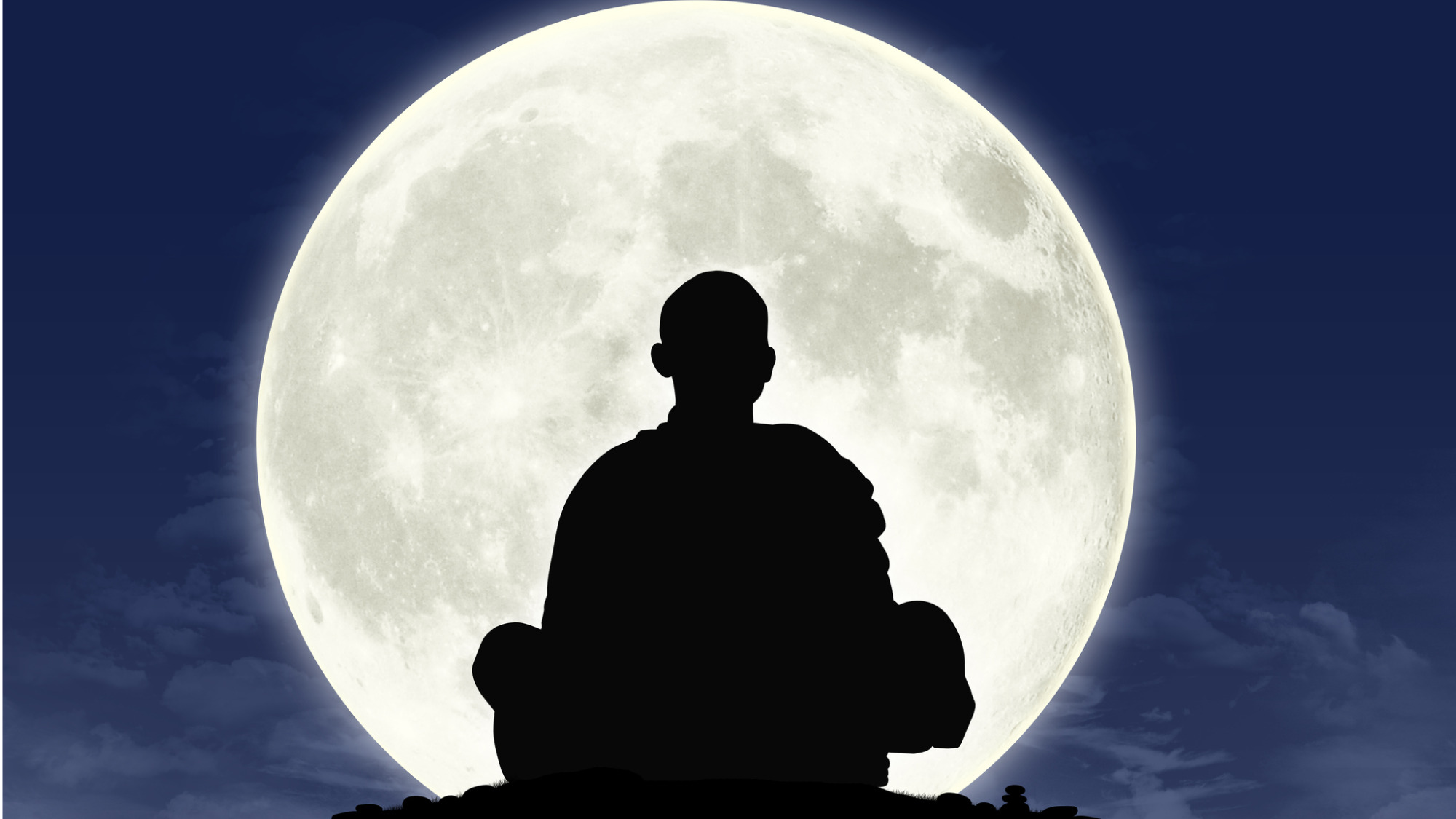
I can really recommend this: especially when everything around you is perhaps sinking into chaos, when everyone is shouting louder and louder and wants to be right, when you no longer know what is right or wrong: don't fall into blind actions, but become calm yourself. Sit down. Breathe. Become completely still. Listen to the silence. And just see what happens. Yes, it can be that simple. The louder it is outside with all the “knowledge” coming at you, the quieter it must become inside you. But we often don't do this because our survival mode automatically switches to flight, fight or freeze. And then we just shout along or look for security on the outside, try to accumulate more knowledge or try to be right.
With the humility or modesty of not being able to know everything, we can instead allow this greater being, namely our Soul, to work in such moments and send us important impulses with which we can act spontaneously and appropriately - even in pressurized or stressful situations. This has nothing to do with passivity or letting everything wash over us. On the contrary - it allows us to remain capable of acting. Because the impulses that we receive from our Soul, if we are open enough to them, mustbe acted upon. Because if we don't follow our intuition, it becomes quieter over time, like a muscle that atrophies when you stop exercising it.
The only requirement is that we maintain the connection to our soul and listen and allow. Your own mindset must be able to perceive the impulses of Spirit. A mindset that already knows everything (better) is not receptive, it is closed. This is actually the case in every area of life. Even a conversation with different opinions quickly comes to an end if there is no openness towards others, no openness to perhaps learn from others or at least be inspired. And new scientific knowledge is just as impossible if we are stuck in old thought patterns and can no longer be open to other interpretations. All of this requires us to be able to admit that we may not already know everything.
How we build bridges with not-knowing
I think this approach to not knowing also has a lot to do with the polarization of opinion that we are currently seeing in the world. The fact that we can't stand uncertainty and ambiguity in a world that seems increasingly uncertain. And then we prefer to feel secure in what we are convinced of, in what we think we know. And what perhaps the people we identify with also believe.
Knowledge can also create identity: With a certain knowledge, or a certain conviction that we know something, we feel that we belong to those who know or think they know something similar. In other words, we build the world to a certain extent the way we like it so that we feel safe and like we belong. If we were to start questioning our knowledge, we feel we would need to give up such a sense of belonging. And that's not so easy. However, this often leads to us thinking too one-sidedly, not being able to question our convictions, starting to defend our “knowledge” or isolating ourselves from different opinions.
This creates separation and separation is in contrast to a spiritual path that seeks connection. This means that on a spiritual path we often have to learn to be ruthlessly honest about our own motivations. Why am I so convinced of this or that? Why is it more important to me to be right with my “knowledge” than to get along well with my counterpart? What am I afraid of if I have to admit to myself that my previous conviction was wrong? What am I afraid of if I change my mind? Am I afraid of rejection? Being rejected by my group? How far would I go in order to feel part of a group, not to lose friends or not to offend my colleagues? Would I even offend them?
Knowing your own motivations is extremely important on a spiritual path. Because only those who know what makes them tick and why, can learn to free themselves more and more from external expectations and really live according to the spontaneous inner impulse of their own Soul - and therefore their own truth.
Uncertainty leaves room for potential
I believe that in life and on a spiritual path anyway, there has to be room for not-knowing, for uncertainty. Because if we already knew everything, where then would be the search, the wonder, the amazement, the curiosity and excitement, where would be the space for new insights, for growth, for vulnerability, for trying things out and making mistakes? For creativity. For new discoveries, for adventure, for spontaneous impulses, for intuition? For collaboration and cooperation? If we knew everything (beforehand), we wouldn't need any of this. We would be detached. And life would be pretty boring and lonely.
Liebe Dorothee
Herzlichen Dank für deinen Beitrag zu meiner Blogparade zum Thema #NichtWissen! Ich freue mich riesig über deinen Ansatz und bin als Atemtherapeutin ganz deiner Meinung:
«Hinsetzen. Atmen. Ganz still werden. In die Stille lauschen. Und einfach mal schauen, was passiert. Ja, es kann so einfach sein.»
Da war ich doch letztes Wochenende kurz weg, an einem wunderbaren Ort mit viel Spirit und freute mich sehr, bei der Rückkehr in den meinen Alltag festzustellen, dass du zum Thema Nichtwissen gebloggt hast!
Auf ein spannendes und aufregendes Leben!
Atemgruss von
Susanne
Liebe Susanne,
dein Thema war aber auch eine Steilvorlage :-). Ganz lieben Dank noch einmal für deinen Aufruf!
Atemvolle Grüße,
Dorothee